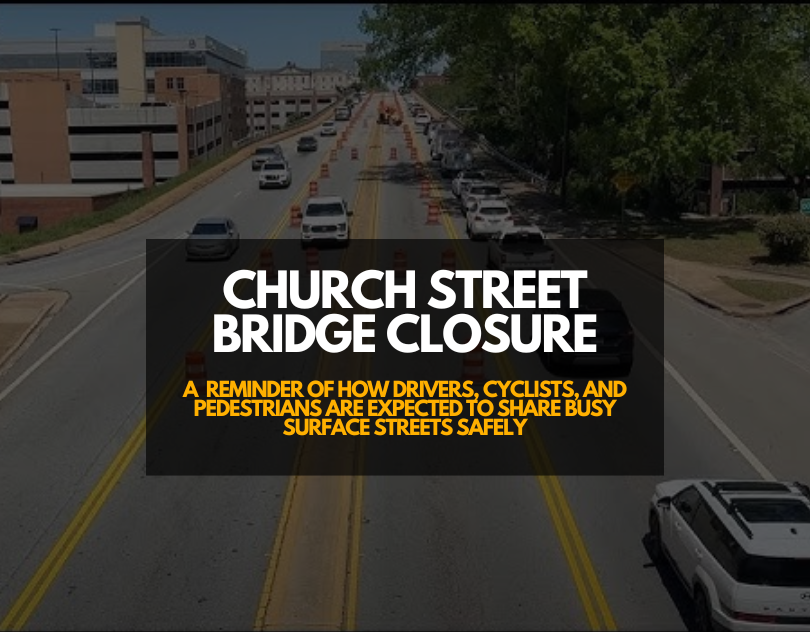
When the Church Street Bridge closes for long-term rehabilitation, most people will think about inconvenience. Detours. Longer commutes.
But for cyclists and pedestrians in downtown Greenville, the concern runs deeper. This closure is not just a traffic issue. It is a safety issue.
Once that traffic shifts onto surface streets and neighborhood routes, congestion will increase in areas frequently used by pedestrians, cyclists, and runners heading to and from the Swamp Rabbit Trail. As drivers navigate unfamiliar routes and congestion builds, the margin for error narrows.
Many of the highest-risk situations occur at intersections. A driver turning right on red while watching for traffic may miss a pedestrian stepping into a crosswalk. These moments unfold quickly.
SC law provides strong protections for pedestrians. Drivers must yield in marked and unmarked crosswalks at intersections. These rules exist because pedestrians are among the most vulnerable users of the roadway.
Cyclists face similar risks. A driver turning left may not expect a cyclist traveling straight through, even when the cyclist has the right of way. These turning conflicts are a frequent cause of serious injuries, particularly when traffic patterns suddenly change.
Bike lanes can also create misunderstandings. In SC, bike lanes are part of the roadway, not buffer space for drivers. During congestion, drivers sometimes drift into bike lanes, placing cyclists in danger. Cyclists are also allowed to leave bike lanes when conditions make them unsafe.
The Church Street Bridge closure will test how well Greenville adapts to changing traffic patterns.
If you’re driving, slow down and scan wider.
If you’re cycling, ride predictably and assert your space lawfully.
If you’re walking, stay visible and alert.
Whether someone is behind the wheel, on a bike, or on foot, an injury can change everything. My team and I work for accident victims across all of these situations to ensure their voices are heard.
Categories
Why Cyclists and Pedestrians in Downtown Greenville Are Nervous About the Church Street Bridge Closure