
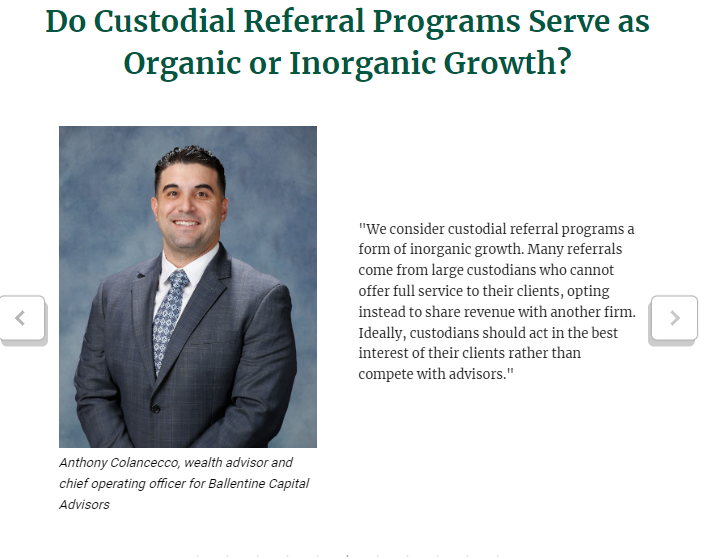
Anthony Colancecco, COO of Ballentine Capital Advisors was quoted by Financial Advisor IQ, in their recent article about whether custodial referral programs are organic growth or not. Read the full article below.
https://www.financialadvisoriq.com/c/4531534/594234/custodial_referral_programs_organic_growth?referrer_module=issueHeadline
Custodial Referral Programs: Organic Growth or Not?
Custodial referral programs provide RIAs a pipeline of client leads, but some advisors say that business generated from these programs falls outside the realm of organic growth, given their revenue-sharing arrangements.
For many financial advisors, the concept of organic growth conjures images of cold-calling prospects or leveraging relationships with centers of influence. Another common book-building strategy, custodial referral programs, would also seem to fall within the realm of organic growth — or does it?
Custodial referral programs provide eligible registered investment advisors a pipeline of leads that can help generate new clients. Fidelity’s Wealth Advisor Solutions program, one of the industry’s most popular custodial referral programs, has more than 70 participants, including Creative Planning, Mercer Global Advisors and Mariner Wealth Advisors.
Charles Schwab’s Schwab Advisor Network, another prominent custodial referral program, also offers RIAs an alternative channel for client referrals. A Schwab spokesperson did not respond to FA-IQ’s inquiry regarding the number of participants in the program.
Do you consider custodian referrals to be organic growth?
Custodial referral programs provide RIAs a pipeline of client leads, but some advisors say that business generated from these programs falls outside the realm of organic growth, given their revenue-sharing arrangements.
Referrals from these programs often surface a “pretty substantial potential client that has fairly complicated needs,” said Steve Sanduski, founder of Wisconsin-based consultancy Belay Advisors. He adds that the client relationships derived from these pipelines can be enduring.
Enrollment in custodial referral programs can also serve as an attractive quality for firms looking to sell their business down the line, said Emily Blue, co-founder and managing partner of Hue Partners.
“Typically, it is something that is highlighted … because of the work that it took to not only get into the program, but to maintain the program and to have success,” said Blue.
However, while the benefits of custodial referral programs are apparent, opinions remain mixed as to the type of growth they provide. Some advisors argue that custodial referral programs constitute a form of natural growth.
“They have all the attributes that you find in organic growth,” said Cerity Partners Chief Revenue Officer Adam Hills. “Custodial referral programs provide new clients, new asset opportunities and new revenue to our practices.”
Cerity Partners is a participant in Fidelity’s Wealth Advisor Solutions program and the Schwab Advisor Network.
Meanwhile, others argue that business derived from custodial referral programs is incomparable to organic growth methods such as traditional referrals and marketing.
“[Organic growth is] any referral or business development pipeline that is created within the walls of the firm,” said Odaro Aisueni, associate wealth manager at Houston-based Willis Johnson & Associates. “I would consider it inorganic because it’s not generated from within the walls of the firm. It’s not actually natural.”
FA-IQ asked 11 RIAs how they categorize business derived from custodial referral programs.